Crime Beat: Whoops


DEARBORN

Police called when man can’t un-handcuff wife


A Dearborn man learned that when you handcuff your wife to the bed, make sure you know where the key is.

Dearborn Police officers responded to a call from a man at 7:15 a.m. Thursday, Sgt. Ray Patrick said. They had to use a universal key.

Posted in Crime Beat | 1 Comment

Transgressive Victorians

I guess you could call my latest researches Transgressive Victorians. We have such an image of the Victorian age as a staid period of buttoned down, pious boring conformity that it comes as somewhat of a surprise to recognize the existence of a small group of anti-deist, sexually bold thinkers whose ideas are radical even by today’s standards.

Ironically, the supposed bedrock of the Empire, the standard classical education in Greek and Latin, was a casual factor in the rebellion. Every schoolboy malcontent was quick to brand himself as pagan, and the literary examples of Petronius, Sappho, Catullus, etc., gave evidence of a broad spectrum of sexuality ignored by the enervating, narrow Christianity of the day. Add to that the pervasive boarding school same sex hank panky and the widespread use of corporal punishment and you’ve got the makings of a pretty kinky nation, even if it was largely on the down low.

I’ve just read biographies of Oscar Wilde (The Secret Life of Oscar Wilde by Neil McKenna) and Algernon Swinburne (Swinburne: The Portrait of a Poet by Philip Henderson), two brilliant authors whose works and personas were vital to Victorian culture despite the fact that their lives and works were deliberately subversive of that culture’s avowed morals and most deeply held values.

I’ve always held that people’s philosophies are merely rationalizations for their fantasies, but only superior intellects like Wilde and Swinburne can turn their kinks into the kind of credos that underlie great works of art. Branded unnatural for his sexual “inversion,” Wilde proceeded to make inversion his aesthetic principle, holding that the artificial was superior to the natural, art more sublime than nature, and man’s creations superior to god’s. Homosexual sex without the possibility of procreation was, he and his fellow “Uranians” claimed, a much purer form of love, uncontaminated by bestial, evolutionary instincts. Wilde’s work constantly dramatizes characters who are not as they appear, who wear masks that conceal their true desires. The Picture of Dorian Gray is, after all, a book about life, sin and art, the principle conceit being an inversion where a painting shows the wear and tear of dissolute living while a living man remains as pristine as a work of art.

As for Swinburne, his masochistic urges led him to embrace an indifferent and even cruel universe. Like all true mystics he was drawn to that place where seeming dichotomies like love/hate or pleasure/pain dissolve and become reconciled, the scene of what his beloved William Blake called “the marriage of heaven and hell.”

The pre-sexual experience of flagellation produced, as Swinburne himself attested, a masochistic proclivity which to a great extent informed his conception of existence.

He was a masochist who believed that existence and its constructs as well as nature itself were informed by the conjuncture of pleasure and pain.

– Semyon Khokhlov

Sadomasochistic imagery and themes are prevalent in Swinburne’s works, yet the use to which he puts them indicates that he is not merely flaunting a psycho-sexual predilection. Rather Swinburne’s poetry sets forth the bold proposition that in nature, love and the major constructs of existence, pleasure and pain are intertwined.

– Douglas Bush


From Sade Swinburne took the idea that God smites equally the just and the unjust, and perhaps the former rather more than the latter; also the other idea that pain and death are everywhere in Nature, that crime is Nature’s law; and the conception of God as a Being of supreme wickedness (the supreme evil, God), and the revolt of man against the divinity he disowns.

– Mario Praz

These beliefs are nowhere more evident than in his little known, unfinished novel Lesbia Brandon. In many ways it’s unfortunate that Swinburne’s inherited wealth shielded him from the commercial exigencies that might have forced him from poetry into the more lucrative field of fiction, because in his prose he’s able to write more plainly and with more perspective than in much of his verse. His two surviving novels, Lesbia Brandon and Love’s Cross Currents are both fascinating books, much closer to French Romantics like Gautier or even a Decadent like Rachilde than any English writer.

True, there’s a somewhat disconcerting preoccupation with flogging in Lesbia Brandon, but the practice of “swishing” adolescent boys was a widespread but little recorded phenomenon which no doubt affected the psyche of the nation. The book occasionally threatens to descend into a superior example of Victorian smut, but, as Swinburne said The pornographer is also among the prophets.

Here’s a couple of extraordinary passages, in which the frustrated and socially improper passion of a young boy’s tutor for his charge’s sister leads to disordered fantasies and ultimately to very real and socially sanctioned violence against the boy, who has the misfortune of much resembling his sister:

The glory and terror of her beauty held down desire and absorbed despair. Rage rose in him again like a returning sea. Furious fancies woke up and fought inside him, crying out one upon the other. He would have given his life for leave to touch her, his soul for a chance of dying crushed down under her feet: an emotion of extreme tenderness, lashed to fierce insanity by the circumstances, frothed over into a passion of vehement cruelty. Deeply he desired to die to her, if that could be; and more deeply, if this could be, to destroy her: scourge her into swooning and absorb the blood with kisses; caress and lacerate her loveliness, alleviate and heighten her pains; to feel her foot upon his throat, and wound her own with his teeth; submit his body and soul for a little to her lightest will, and satiate upon hers the desperate caprice of his immeasurable desire…

There was a singular light in the man’s eyes as they followed her passing out after this speech; a sharp hard look with a cruel edge to it, but full of hidden heat; the light and heat of dumb desire, of desperate admiration, of bitter and painful hatred. Something too of wayward and hopeless pleasure was in their dark grey globes, latent and tacit. Suffering, self-contempt, envy and the rage of inverted love and passion poisoned in the springs, all were absorbed by the keen delight of a minute while her skirt brushed him and her eyes touched him. A pungent sense of tears pricked his eyelids and a bitter taste was one his tongue when he went out. Her god-like beauty was as blind and unmerciful as a god. Hating her with all his heart as he loved her with all his senses, he could but punish her through her brother, hurt her through his skin, but at least to do this was to make her own flesh and blood suffer for the pain inflicted on himself.

Posted in Books | Leave a comment

Nixon’s Enemies and My Triumph


Never forget. The press is the enemy. The establishment is the enemy. The professors are the enemy. Professors are the enemy! Write that on a blackboard 100 times and never forget it.

– Richard Nixon to Henry Kissinger in the Oval Office, December 14, 1972


At last something I wrote has achieved immortality – I’ve tried so many times to get a question in the Steelers Q & A feature in the online Pittsburgh Post Gazette that it came as quite a shock when I finally saw my words in print, offered to the curious Steeler Nation:

http://www.post-gazette.com/pg/08343/933700-367.stm

It’s funny that when asked my hometown I still say Pittsburgh even though I’ve now lived here longer than I did there – to me your hometown is where you were born. I also think, based on past rejections, that the editor might have something against Ann Arbor, probably because of what we did to Penn State a few years ago.


Posted in Culture | 4 Comments

Haiku


In the bus station

The beautiful young woman

With only one eye


Posted in Poetry | 1 Comment

Hmmm..Maybe We Should Eat Mexican Tonite..


Chinese Tonite Restaurant

Date: Sept. 30

Number of critical violations:

3

Critical violations:

Several employees were observed rinsing hands off without using soap to clean (corrected.) The chicken broth was cooling by using improper methods (corrected.) Egg rolls were improperly chilled (corrected.)

Noncritical violations:

Shelves were improperly lined. The facility needs to be cleaned better, more frequently. Live adult and baby cockroaches were found; pests need to be controlled, exterminated. Several items were found to be cooling by potentially hazardous methods rather than rapid cooling methods. The walls need repair in several areas. The floor has puddles that pool up and needs to be fixed. The rear handsink didn’t have soap provided. Dish racks were moldy. Food was stored in unapproved containers. The faucet has a leak. Cloth towels weren’t sanitized.


Posted in Food and drink | Leave a comment

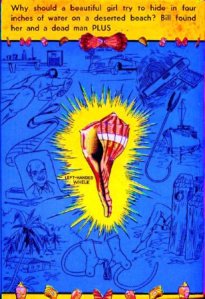
Shell Game!

Another treasure from the hoard of the hoarder!
 
Posted in Books | Leave a comment

Swinburne: The Poet


As I said previously, I’ve been reading a lot by and about the improbable Victorian Algernon Swinburne. He’s not very well known these days, despite possessing many qualities and concerns that appeal to the contemporary spirit. After all, he lived the first part of his life as an enfant terrible, precocious and fearless as Rimbaud, saying, doing, writing and championing the most radical things imaginable, a real we piss anywhere, man type rock star, who, if he had dies young, might be remembered the same way as his heroes Keats, Shelley and Byron. But despite sincere youthful efforts at dissipated self-destruction, he lived on, proceeding directly from tempestuous adolescence to a staid and unforgivably boring old age full of rote verses and reactionary views.

Despite Swinburne’s mastery of all known verse forms, even his brilliant early work can be hard going for today’s reader. Part of it is our fault – when poetry is conceived of at all these days it’s as a relatively brief lyric. Even the great epic of modernity, T. S. Eliot’s "The Wasteland," would be considered short by Victorian standards. Part of it is that the antique poets such as Sappho who were most admired by the modernists have survived mostly in fragments, giving a distorted sense of the epigrammatic, unfinished quality of their work, much like our incomplete conception of Classical statuary, which, of course, was never meant to be viewed sans arms, legs or color. In contrast, the men of England’s Victorian prime were entirely comfortable with vast epics like the Aeneid, and cut the cloth of their own verse accordingly. The dehumanizing conflagrations of the twentieth century have shrunk the scope of poetic vision, and the pulse of the electronic age has both quickened and shortened humankind’s attention span. We no longer have patience with the idea that a universal completeness can or should be contained in a work of art, evidenced by the changing critical fortunes of, say, Longfellow and Emily Dickinson.

But it’s not all our fault. Even the most dedicated booster (if such a creature exists) would have to admit that Swinburne’s early and best work is far from perfect. Like Poe, it’s hard work to hack your way through Swinburne’s wordy convolutions, but, unlike Poe, who always maintained a brilliant concern for overall effect, it’s not always worth it. As some critic I read somewhere along the line said, Swinburne’s intent is largely percussive. He’s a slave to his own insanely powerful rhythm, and once he’s got the hooves of his great poetic steed thundering, it’s hard for him to rein it in. Many times a Swinburne poem overshoots a seemingly ideal and conclusive stopping place only to continue madly over the cliffs of anti-climax.

However amid the din and drone there are passages that are simply astonishingly radiant. Like his friends the Pre-Raphaelites, it’s not the obscure myths or the fuzzy politics that arrest, but the brilliantly visionary details, the glowing sacralization of sensual life. In an eternal moment the contradictions between life and death, nature and man, pain and pleasure are dissolved in the ecstasy of beauty.

Here’s one of my favorite examples, a little riff about pagan and Christian, in which Swinburne contrasts Mary and Aphrodite:


Not as thine, not as thine was our mother, a blossom of flowering seas,

Clothed round with the world’s desire as with raiment, and fair as the foam,

And fleeter than kindled fire, and a goddess, and mother of Rome.

For thine came pale and a maiden, and sister to sorrow; but ours,

Her deep hair heavily laden with odor and color of flowers,

White rose of the rose-white water, a silver splendor, a flame,

Bent down unto us that besought her, and earth grew sweet with her name.

For thine came weeping, a slave among slaves, and rejected; but she

Came flushed from the full-flushed wave, and imperial, her foot on the sea.

And the wonderful waters knew her, the winds and the viewless ways,

And the roses grew rosier, and bluer the sea-blue stream of the bays.


Posted in Literature | Leave a comment

Letters We Never Finished Reading

 
Dear Manager:
 
It’s Up to a Gay CIA Agent to Save the World — From Gay Neo-Nazis.
 
Sometimes the only thing standing between the free world and the end of Western civilization is a hunky — and openly gay — CIA agent. But when the enemies of freedom are gay neo-Nazis? Now things are really starting to get interesting…
 
Welcome to "Rainbow Spies: La Conclusion Francaise," a fast-paced and savvy thriller from author William Green. Just released from Outskirts Press, this Tom Clancy-style novel mixes equal parts intrigue, pulse-pounding danger and sensous same-sex romance.
 
Posted in Books | 1 Comment

Happy Thanksgiving!

sarah-palin-turkey

Posted in Seasonal | Leave a comment

Swinburne: The Maiden Body And The Scaly Coils


I’m rolling a little number about transgressive Victorians, especially Wilde and Swinburne. To tide you over until the time I fire it up I’ll share this delicious toke from the latter, who (I guess I shouldn’t have been surprised to find out) had a lifetime fascination with serpents. In the coincidence department, Cleopatra was on last night and I watched in a daze, not really listening just digging Liz Taylor’s sublime corporeal manifestation:

Notice has not yet been accorded to the subtle and sublime idea which transforms Cleopatra’s death by the asp’s bite into a meeting of serpents which recognize and embrace, an encounter between the woman and the worm of the Nile, almost as though this match for death were a monstrous love-match, or such a mystic marriage as that painted in the loveliest passage of Salammbo, between the maiden body of the priestess and the scaly coils of the serpent, both made sacred to the moon; so closely do the snake and queen of snakes caress and cling. Of this idea Shakespeare also had a vague and great glimpse when he made Anthony murmur, Where’s my serpent of old Nile? mixing a foretaste of her death with the full sweet savor of her supple and amorous pride of life. For what indeed is lovelier and more luxuriously loving than a strong and graceful snake of the nobler kind?

– Algernon Swinburne


Posted in Books | Leave a comment