
Here’s my anglo-saxon style riddle, most appropriate for this time of year:
I lie in the gutter outside the house where once I was an honored guest.
What am I?
A christmas tree.
I have more memories than if I’d lived a thousand years!
A giant chest of drawers, stuffed to the full
With balance sheets, love letters, lawsuits, verse
Romances, locks of hair rolled in receipts,
Hides fewer secrets than my sullen skull.
– Charles Baudelaire
Bethany – Part Nine
Another part of that same process of enlightenment was the long overdue realization that conversation involved both talking and listening, and if I wanted to get to know a girl I wasn’t going to accomplish it by my former method of sitting there blabbing about myself. Rather than trying to impress Bethany with my wit and erudition, I now knew enough to try and impress upon her my very real interest in her, and I soon learned that despite having spent three years in such a small school together I knew next to nothing about her.
Everyone knew her father was, if only because his name was on the realtor sign in front of almost every house for sale in Fox Chapel. He was a prominent citizen of the suburb, but not quite of the first rank, being a little too brash and a little too Catholic for the prevailing WASP tastes, although the days when people who made a lot of money were seriously stigmatized for such things had passed. I had no idea, however, that before Pitt Prep she’d attended an institution called Saint Scholastica, or that she was the oldest of ten children. She also revealed to me a strata of activity I’d only been dimly aware of, a world of bake sales, of float making, of various harmless, mostly ceremonial Senior "pranks," all instigated by Bethany. There’d even been an all girl road trip to Western Reserve Academy in Hudson, Ohio in order to cheer the football team on. In my entire time at Pitt Prep I’d managed to avoid exhibiting any school spirit, so all this was foreign to me, and interesting in an anthropological sort of way.
But really impressed me was Bethany’s genuine enthusiasm, her energy, her ingenuity – and to what end? She wasn’t one of those camp followers (to whose ranks I bitterly included my crush Virginia) whose school spirit was just a displacement for their devotion to some jock – clearly despite all her spunk and spirit the lunkheads had never been able to see past her unprepossessing exterior.
No, all this passion was an essential part of her, a controlled lust for life, a committed engagement with all the proper available opportunities that I could only marvel at, a hunger for experience the extent of which was soon to surprise me. It was even reflected in how she ate her BLT with an honest appetite, a graceful middle ground between big Tina over there gobbling fistfuls of fries with both hands and anerexo Debbie next to her, idly stabbing the desiccated tomato in her salad as if it were her worst enemy.
Of course, new as I was to the two way conversation thing, the proceedings could occasionally take on the appearance of a cross examination, a fact not lost on Bethany. "So why are you all interested in this all of a sudden?"
"I don’t know. I guess I just figured out all I was missing." I didn’t think the whole enlightenment thing would play very well at the moment.
"Hmmmm…"
But there were relatively few wrinkles in the evening’s smooth unfolding, no long pauses or moments of disapproval or incomprehension. I was clearly getting better at getting along with people and Bethany had just as clearly always been a natural at it. And so time passed quickly, and we talked even after our plates, empty except for the ancient garnish, had been taken and the waitress tired of refilling our water glasses. Ever the traditionalist, Bethany made only a token protest when I picked up the check, and we walked out almost unobserved, most of out classmates having already moved on.
Heather – What?
Charlie – Well, it’s just…what happened in the cave, or what it seemed to me happened in the cave – I mean, was that real?
Heather –
Real? (Laughs) Who knows? No, seriously, Charlie, I’ll tell you how I think about it. Let’s say – let’s say when you’re asleep and you’re dreaming, right? And you wake up and you’re all scared and excited because of some dream that you’ve been having, and you wake up and you say whew, that wasn’t real, but you’re still sweating and everything and what you felt and thought was just the same as what you feel and think when you’re awake. So what’s the difference? Is what you feel in the real world any more real than what you feel while you were dreaming or high or whatever? It’s not the world that’s real, the only thing that’s real is what you feel, Charlie, and that’s all that’s real. Pain, fear, lust, ecstasy – sensation, that’s what Keith always said, sensation is god.
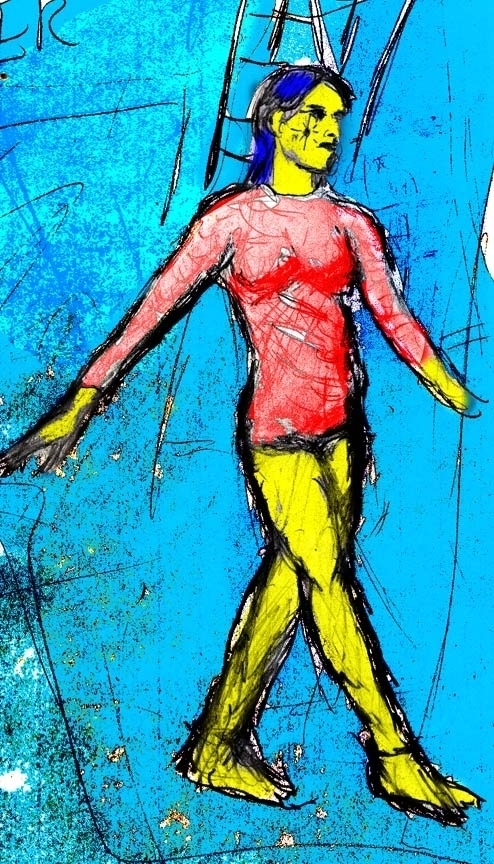
This sonnet of Rilke’s has always reminded me of Heather Harley (1959-2005) a Eurydice of sorts , described by Ungie as “adventurous” and her obituary as “vivacious,” both of which work for me…
XVIII
Dancing girl: transformation of all transience into steps:
how you offered it there.
And the arm-raised whirl at the end,
that tree made of motion,
didn’t it fully possess the pivoted year?
Didn’t it, so that your previous swirling might swarm
in the midst of it, suddenly blossom with stillness?
And above, wasn’t it sunshine, wasn’t it summer,
the warmth, the pure, immeasurable warmth
that you gave?
But it bore fruit also, it bore fruit, your tree of bliss.
Aren’t they here in their tranquil season: the jug,
whirling to ripeness, and the even more ripened vase?
And in the pictures: can’t we still see the drawing
which your eyebrow’s dark evanescent stroke
quickly inscribed on the surface of its own turning?
I’ve been waiting in a lot of lines today (among many other things) but it isn’t all bad because I have my handy SHAMBHALA POCKET CLASSICS edition (which I don’t think they make any more) of RAINER MARIA RILKE’s THE SONNETS TO ORPHEUS in the fabulous STEPHEN MITCHELL translation and was able to find a few gems therein for you, my beloved, loyal readers.
Sometimes, especially as year blends into year, I wonder why I keep going on, pissing out my work to an indifferent world, the answer being, of course, that I can’t help it, but wouldn’t it be nice if what RILKE promises were to really come true in 2007:
He who pours himself out like a stream is acknowledged at last by Knowledge;
and she leads him enchanted through the harmonious country
that finishes often with starting, and with ending begins.
I always thought this would make a good yearbook quote:
Anxious we keep longing for a foothold –
we, at times too young for what is old
and too old for what has never been;
doing justice only where we praise,
because we are the branch, the iron blade,
and sweet danger, ripening from within.

Conclave
The secret conclave has come sooner than I expected
There’s been some mistake in certification
And we must all go back to school
She goes to the next lunchroom table
Come on
Why are you always avoiding me?
It’s an age since I came here she says
And now I gather you expect to scheme darkly
I notice the priority she grants me
And it pleases but
There’s a strangeness to the faraway intentness
Of her eyes and I begin
Not to understand
A Mused (Part Four)
If, as I pointed out in Part Three of this essay, it’s true that the supernatural needs humanity, it’s equally true that humanity needs the supernatural, something our contemporary age seems to have forgotten. Sure, it’s the case that, despite all their mewling about being persecuted by secular society, Christians have more power, both socially and politically, than they’ve had for a long time, but is modern Christianity about the supernatural anymore? Flip through the channels some Sunday morning and you’ll see the message these days doesn’t have much to do with a numinous or awe inspiring God, or even hellfire and damnation. For the king of the evangelicals, George Bush, God is just an enabler, an encounter with whom, rather than being humbling, has filled our worst president with fatal hubris and allowed him to sleep soundly at night. The entity presented by popular preachers is not an "other," but a sort of familiar, a pal, a kind of fuzzy Dr. Phil Jesus home boy.
The relationship with the supernatural is now conducted entirely on the material plane, with God presented on T.V. as a sort of superior stockbroker – just invest a few bucks in the ministry of his close associate the preacher and you’ll get a fantastic return of health, wealth and prosperity. There’s a Tibetan Buddhist guru in my town, the brother of a now deceased, even more famous Tibetan guru, who in the middle of a benefit for his local operation that featured Patti Smith and Allen Ginsberg got up to tout Buddhism as primarily a great way to lose weight and stop smoking. In reality, whatever its supernatural origins, religion has become thoroughly housebroken, just another tentacle of the materialistic/statist/capitalist octopus. Even Islam, the only religion people still seem willing to die for, has been manipulated for geo-political ends rather than mystical ones.
Not that I’m lobbying for organized religion by any means – I wish that all the superstructures that obscure man from the numinous could be ripped away, but the apparatus serves too many interests and makes too much money for that to happen. I think it was partly a reaction against the ossification of religion that caused the Romantics to elevate art as a substitute in the first place, and I guess I still believe, along with all those ancient cave painters, classical sculptors and weird nineteenth century symbolists, that art is the best vehicle for reaching the supernatural. To me Modernism was just a redefinition of Romanticism, and Post-Modernism a further variation, but now the dictionary’s been closed and we live in a deeply anti-Romantic age. When I was young my ambition was to join a modern art movement like the Fauves, Futurists or Surrealists, but today there are no viable art movements, only inviolable art professors. The Situationalists of the sixties and the Punks of the seventies, who were in their own way Romantics, were increasingly despairing and nihilistic reactions against consumer society, all the more poignant because they knew that they themselves were doomed to be consumed. No future, indeed.
An example of the current deeply anti-Romantic spirit can be found in an essay that has haunted and nauseated me by that master of the Zeitgeist, Stephen King. In La Belle Dame sans Merci Barbara Fass equates the profound feelings of helpless attraction and deep fear engendered by the titular lady in the Romantics to their conception of their own muses, beings of supernatural allure who inspired but could also lead them into madness and meaninglessness. King doesn’t see his own muse in quite the same way – to him it is "…one small animal, sometimes quite vicious, that makes its home in the bushes. It’s a scruffy little thing with fleas and often smells of whatever nasty mess it’s been rolling in." This whole A Mused train of thought began for me with the images of Klimt’s muses, the implacable, otherworldly goddesses, the naked truth he struggled to portray. One need only place one of these magnificent visions next to King’s flea bitten mutt to see how debased our age has become.
It’s a new kind of Classicism, guilty of exactly what Fass quotes Robert Graves as saying was the defect of the mode:
The Classical poet, however gifted and industrious, fails to pass the test because he claims to be the Goddess’s master – she is his mistress only in the derogatory sense of one who lives in coquettish ease under his protection.
King doesn’t even grant his muse a human form, but presents her as a semi-domesticated beast who comes if not impeded by muse repellent, and then apologizes for being "too lyrical."
The old Classical template demanded that art serve society by being "morally uplifting," and that’s still in effect in academic circles both left and right, but what’s been added to the equation, as it has been added everywhere, is money. Except for politically motivated ones, money is now our only yardstick, our only value. Art is no longer about aesthetics – believe me I know, there’s a contemporary art gallery next to me run by a college professor in the strictest highbrow style and how the "pieces" look is considered the least important thing about them, and in fact the works themselves are nothing next to the conceptual/political concepts that "inspired" them and their hoped for collectability. Whatever King’s virtues, they don’t extend to his work’s most basic component, his awful, cliche ridden prose, as evidenced by his risible advice to would be writers to forget about le mot juste and just slap down the first word they think of and forget about it.
That would be fine if King, after years of lobbying the literary establishment, wasn’t finally getting serious critical plaudits. Since all other critical values are bankrupt, the fact that he’s sold so many books over such a long time has forced the book world to take him seriously. That the latest pissing of his mangy muse was declared a notable book of the year by the New York Times Sunday Book Review is more testimony to the cluelessness of the literati than to any sudden flowering of his talent. Just has commercial success has made King artistically notable, the forces that cause The Color Purple to be declared the greatest novel of our time have more to do with politics than art.
We’re a culture driven entirely by money and power, on a headlong course away from the Romantic conceptions of the inspired artist, art for art’s sake, and beauty being truth and truth beauty. One of the reasons for this flight can be found in another disturbing essay called "A Youthful Intoxication" in which Cynthia Ozick dismisses her early infatuation with the Romantics and mysticism. Fortunately, she says, she was cured by reading one Rabbi Baeck, who introduced her to "the classical, ethical idea of history." It’s perhaps a little catty of me to say that the accompanying photo of Ozick reveals a woman who has little consideration for the aesthetic, a wearer or sensible shoes if there ever was one, but the real reasons for her terror lie deeper. There is a real irrationality about Romanticism, one that, as Fass points out, the Romantics both feared and sought. Though Ozick is too classically circumspect to say it, the subtext of her aversion to the Dionysian is the blind, atavistic violence that can emerge from the ecstasy, a violence she unspokenly equates to the detestable sacrifice of eight million of her fellow Jews at the hands of the Nazis.
I’ve written before about the troubling connections between Modernism and Fascism, and the similarity of their anti-moralist stance and aesthetic preoccupations, but to blame the Romantics for the Nazis is crude reductionism, which is probably why Ozick hesitated to ink in her dotted line connecting the two. Her motivations for running screaming to her Rabbi when first confronted by the wild face of the muse must remain obscure, but no doubt help account for the mediocrity of her literary career.
The contemporary reaction against Romanticism is tied to its alleged complicity in the horrors of the twentieth century, but it’s also useful to ask whose interests a specific line of thought serves. The ideals of Promethean rebellion, uncontrollable ecstacy and allegiance to an otherworldly muse are just as threatening now to institutional power as they were when the Romantics first took up arms against Classicism. Does it serve the powers that be more to have artists see their muses as implacable goddesses or mangy mutts? Of course Ozick’s Rabbi Baeck would disparage a concept that would so diminish his own power as mediator between God and man. But that’s the thing about the goddess, as the Tannhauser myth shows, she can be exiled but never really restrained. Despite the evident bankruptcy of a culture that would have Stephen King as one of its leading literary lights, you’ve just got to hope that this is just one of those periods of transition when nothing much is happening artistically. Eventually the goddess will speak again and shoo all those mangy dogs away.
O.K., I admit it – except for short stuff like Death in Venice and Tonio K. I haven’t read Thomas Mann, which is sort of shameful considering he’s such a towering figure in modern literature, etc. I guess it was partly because I thought he’d be too square and partly because I thought if I hadn’t read it him by now it was too late and too obvious, or something like that. But the last chapter of Barbara Fass’s La Belle Dame sans Merci, which I’ve been endlessly referring to (and it ain’t over yet – hopefully the final part of my essay "A Mused" will appear tomorrow) is all about The Magic Mountain, which she says is a variation on the Tannhauser theme, and commentary on Romanticism, so I finally picked it up. It’s certainly presumptuous of me to tell the world that Mann’s a good writer, but he is, and The Magic Mountain is a enjoyable read so far, although I don’t think he’ll become one of my favorites – I fear I was a little right about that square thing, though if you have to chose between that and the Nazis certainly square is the way to go.
Anyway this is my favorite passage so far, which is predictably about the Venus of this particular Venusberg, the mysterious Madame Chauchat: (The ellipsis are Mann’s as translated by Johm E. Woods).
Hans Castorp grimaced, but his eyes remained fixed on Madame Chauchat’s hand, and a vague, halfhearted recollection passed through his mind of something Dr. Krokowski had said about corrective bourgeois forces that counteracted love…But this arm was more beautiful, this arm bent gently behind the head – and was barely clad, because the fabric of the sleeve was thinner than that of the blouse, the flimsiest gossamer, which lent the arm just a hint of delicate illusion, making it even prettier than it probably would have been without any covering. It was both tender and full at the same time – and cool one could only presume. There could be no question whatever of any counteracting bourgeois forces.

