Cappy’s Café


Slim pure forest dark

Sweet in your prime

Glittering jewelry

Spiral bracelets

And shining earrings

Double strands of

Deep blue beads

Transcendent

Immanent

The goddess

In matter

Sitting straight

As the sacred oak

Whose thighs are holy

Specifically in this instance

Outside Cappy’s Café

As you uncross your legs

Under the glass table top

The contents of the shadows

Superluminous in gloom

Flesh and fabric whatever

Desire permits

Your skirt the city

Your tender frame

A creeper on

The brick wall


Posted in Poetry | 1 Comment

Hair Today Goon Tomorrow

Fox Chapel High 1987

Isn’t it funny how the thing that is most fashionable at the time can seem the most ridiculous a few years later? Although I prefer style (it’s cheaper), I have nothing against fashion because it’s the principle way that ideas are popularized these days. So what’s the concept behind this look? Bigger is better is what springs to mind, and it’s actually not as flip an idea as it sounds. After all that was one of the guiding principles of the Reagan years – big business, big military, big brother – even government, which he famously derided, quickly became bigger than ever under his guidance. The thing about fashion is that whatever is fashionable inevitably becomes un-fashionable, even if that thing is cool. Look at the Rolling Stones, the eternally greatest Rock and Roll band who are soooo out now for having the temerity to grow old and remind the boomers they’re growing old too – at least half the Beatles had the grace to die young where they can remain comfortably in nostalgia. The first thing I see when I look at this picture is artificiality – like Reagan, the hippie arch-nemesis, you can see this do as a reaction against the fashions and hence the ideas of the sixties, a time when a whole lot of new concepts that were bubbling at the avant garde margins finally broke into the mainstream. The naturalism and "authenticity" so prized by the age of Aquarius, which expressed itself in long, straight hair and very little make up has found it’s opposite here. Of course that look was itself a reaction against the made up artificiality of the fifties and here the cycle has recycled back to the bouffant. Not that there’s anything inherently wrong with artificiality – after all it’s the guiding impulse of my beloved decadence, and self-aware artists like Roxy Music and David Bowie were able to do great things with it – but the results in suburban hair styles were not so good.

Posted in Culture | 1 Comment

From The Great Lakes Literocity Arts Center Collection of the Americas

INNOCENT…

BUT DEADLY!

Tia, wild as a summer storm, drove men – and women – into a frenzied plunge into erotic sensuality! For Lisa, older but not wiser, Tia awoke the ecstasy of unnatural love. For Frank, she was the spawn of Satan. For herself…there remained only the pit of despair…until real love saved her!

Posted in Books | Leave a comment

Novelization and Its Discontents

I’ve just completed a fairly odd and apparently purposeless project (my favorite kind!), inspired, as per usual, by books that caught my eye. I kind of collect novelizations of obscure movies for the store, and two of them intrigued me enough to go the extra mile and get the movies on e-bay (cheap) too. You have to love the titles – "What the Peeper Saw" and "Picture Mommy Dead." I think it was when I put the latter in the window for the Mother’s day display that I figured I might as well read it. It’s got a great cheese cover – a woman (I thought it was Zsa Zsa Gabor, but it’s one Martha Hyer) holding a candle and a pair of scissors, menacing a little girl. The funny thing is that it’s not a still, but a set photograph, and it’s clear that it’s one of those prop candles with a light bulb in the body – you can see the piece cut out of the plastic and even a cord and a battery in the actresses hand. "What the Peeper Saw" has a seventies photo cover of a screaming, naked woman’s whose vitals are artfully obscured by rippling water.

I don’t think I’ve ever read a novelization before. I’m not sure why they exist, really, except as some promotion for the movie. They don’t seem to do them that much anymore, which is probably good. Everybody knows that a novel is almost always better than the movie they make of it, and I guess that you should really see the movie first so it’s less disappointing. I’m not sure of the etiquette with novelizations, but I read the books first, and really I can’t say any of the four, books or movies, were that good, but, of course, the discerning mind finds interesting speculations from any material. In the absence of such a mind we’ll just have to go with what I came up with.

With "Picture Mommy Dead," the screenwriter was also the author of the novel, which, I suppose might have even been conceived initially as a novel. Robert Sherman adds a rather ornate, and often faintly ridiculous, Faulknerian prose style to his Southern gothic. A girl returns to her old Southern mansion from the insane asylum after her mother’s death – but is she still crazy or a victim? And exactly how was her mother burned alive? The written word is capable of unlimited production values and perfect casting, something the film makers were denied. The venerable Don Ameche certainly brings a presence to any film, but Zsa Zsa Gabor’s Hungarian accent couldn’t pass for Southern in any universe, despite the cameo nature of her role. The young girl didn’t seem attractive or talented enough to be pursuing acting, but I have since learned she was the Producer/Director’s daughter. The film wasn’t unwatchable, a mildly entertaining slice of creepy camp, but the book doesn’t add much but overwriting.

"What the Peeper Saw" is also known as "Night Child," or even more puzzlingly, "Night Hair Child." There’s an exploitation element to it, which is always good, as well as a sort of foreign film feel, as it was one of those dual Spanish/English deals. The boobs are bared from the opening shot, but really only tease from then on. There’s also an ambiguous child with a dead mother at the center of this tale, the young genius Marcus who is certainly odd but may or may not be evil, a distinction his new step-mother may be dying to find out. Although many seem to be turned on by the young star of "Oliver!" playing such a sinister role, Mark Lester doesn’t really convince as a preternaturally sophisticated moppet, an idea that’s really more tenable in abstract prose than on the screen. I thought Britt Ekland was largely convincing in her role, and certainly brings an erotic charge to the screen. The kid/adult erotic angle adds a frisson, but the movie remains kind of clunky. Again, not unwatchable, but not especially compelling either.

The book is novelized by one Jack Gratus (did he work for free?) from Trevor Preston’s screenplay, and it’s significantly different. For one thing, it’s in the first person, which brings an added ambiguity to the stepmother’s paranoia. Gratus creates the rather affecting voice of a swinging cool chick of the era that Ekland couldn’t pull off without a voice over. The most surprising part is the differences between the book and the movie, including the ending. I’m assuming there was a late change in the script, but I think the book’s ending is a little more subversive. All in all, I guess this tandem was a little more to my liking, although I would hesitate to strongly recommend.

Here’s my fave quotes:

He knew her body well. He knew all its secrets. He knew its grace and its infamy; its pride and its vanity; its nobility and its vulgarity. How like a queen the slut is, he thought.

from Picture Mommy Dead by Robert Sherman


"Sounds hip,: I said flippantly.

"Good fun all around," Paul said with a sneer.


In the center, stretched out on a table was a pretty young black girl. She was naked and she must have been really bombed out of her mind on drugs or something to allow them to do what they were doing.


I thought it looked quite clever – a sort of impromptu happening. But the atmosphere was wrong.


"Here, Slam," someone said, handing the big man a slim cigarette. "Give her this. She’ll feel better.

Slam put the joint between the girl’s lips. "Pull on that," he snapped.


She swayed. "Well, once upon a time there was this beautiful woman who had this beautiful husband and this beautiful son and everything was beautiful for them because they were all rich and beautiful. Then…"


Jesus Christ, 1970’s style!

I thought.


It’s uncool to show too much emotion.


"Drop the paperback psychology, Paul," I said. "It doesn’t impress me."


I thought to myself: I bet you do, Doctor.

from What the Peeper Saw by Jack Gratus

Posted in Books | 1 Comment

(Then We Will Remember) Graduation Day

Well, my daughter has graduated from high school, which is why I missed my blog yesterday. Hopefully most of you have survived the crushing disappointment. I’m still recovering from the graduation party (not the partying, but the setting up and tearing down) as was as the continuing draining presence of my closest living relative but I do have a few gems from notes I jotted down during the marathon ceremony.

Here’s a phrase of wisdom from the class president, who was no advertisement for the excellence of the English department:

We will remember the successes we have endured.


And, I know it’s immature, but as I listened to the over 630 names as they were being called out I couldn’t help having a few of them hit my ear in a tingly way:


Claire E. Eisentrout

Miriam Elynn Weaverdyck

China Whitehead


Anyway congratulations to all…

Posted in Entertainment | 2 Comments

UBULOGO

Posted in Shopping | Leave a comment

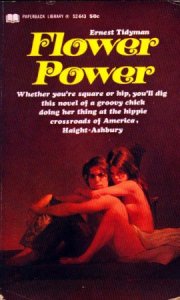
From The Author of Shaft

Phyllis Greenfield was sweet sixteen – and never been stoned. Life was passing her by.

So she ran away from her comfortable home in Cleveland, Ohio, and went to Haight-Ashbury to make the Underground Scene.

There she met Furman, a young Black acid-head who wanted to be a FBI agent – or at least a member of the Hell’s Angels. Furman rechristened her "Flower" and brought her to his crash pad where she settled down to making the protest rallies with Me, a mystic love-child who took her to a swinging guru. And Signal, who caught special vibrations by making sex a mixed-media happening. And Tripper, who convinced her that LSD was the only ticket to visiting Inner Space.

Flower was grooving in the switched-on life until one day the straight and the hippie worlds clashed in a battle that taught her the true meaning of FLOWER POWER!

Posted in Books | Leave a comment

Event

Hey, it’s nice to get some media attention for what we do. Maybe the virtual journalists will prove more sympathetic than those newsprinters…
 
Posted in Books | Leave a comment

Ivan Buin: Dark Avenues

I admit it – when I saw Dark Avenues by Ivan Bunin at the library sale I thought twice about buying it. True, it was in a cool UK “Oneworld Classics” edition, (with a largely inappropriate cover illustration – to my mind “Memories” by Fernand Khnopff would have been perfect), it struck me of the kind of mid-century Russian realism that can be tedious. I’d read The Gentleman From San Francisco and Other Stores years and years ago when I was remedying the astonishing fact that I hadn’t really been exposed to any Russian literature in college, but it obviously hadn’t made much of an impression on me as I hardly remembered Bunin. I did know from more recent researches that he was seen as the antithesis of my beloved Russian symbolists, and in fact one of the blurbs from the book is Andrei Bely’s “I have been keeping an eye on Bunin’s brilliant talent. He really is the enemy.” The fact that he won the Nobel prize in 1933 didn’t sway me much either — it seems like it was, as is so often the case, as much a political, anti-communist statement as an artistic one. But one phrase in the back cover copy sealed the deal, “…this collection of short fiction centres around dark, erotic liaisons.” Say no more, UBU is there!

And so it sat in the vast book pile until, inexplicably, I got a hankering for it months later. And yeah, it’s all that, and even more. After time the competing claims of different schools don’t seem that exclusive anymore (like, say, disco and punk) and these brief, highly charged stories reminded me as much of the symbolist images of Munch and Klimt as much as anything else. Maybe because they were composed between 1938 and 1944 during Europe’s nightmare years, they seem like a vivid, escapist mix of dream and memory, daydreams of man’s favorite daydream, woman. There’s no fantasy element to them, however, but a real sense of Russian tragedy, of the brutal beauty of Tzarist life, and the eternal dance of death between the sexes. Far be it from me to compare my humble UBU efforts to such work, but I will say that it made me feel better about the stuff I’ve been doing lately, which is similarly brief, somewhere between a short story and a prose poem, and largely lacking the encyclopedic, academic delineation of every detail that the MFA programs promulgate. Like UBU Bunin is obsessed by the physicality of women, their hair and skin and bodies, but also the clothes and accessories they surround themselves with, their movements and even the breath that animates them. A woman in his society had very little manifest power but often an ocean of latent effect, which in turn can either anger or bewitch the men around them.

Here’s a few beautifully written passages, many of which might be called figure studies:

She used to sit down freely on Levitsky’s knees – as though innocently, childishly – and probably sensed what he was secretly experiencing, holding her plumpness, softness and weight and trying to keep his eyes off her bare knees under the little tartan skirt.

“Everything passes my friend,” he began mumbling. “Love, youth – everything, everything. The ordinary vulgar story. Everything passes with the years.” “God treats people differently, Nikolai Alexeyevich. Youth passes for everyone, but love’s a different matter.”

I looked at her felt boots, at the knees under the grey skirt – everything was easily visible in the golden light falling from the window – and I wanted to shout out: Better you kill me, I can’t live without you, for those knees alone, for the skirt, for the felt boots, I’m prepared to give my life!

He had smiled awkwardly, had stood for a little and watched how, with a mallet in her hands, she bent toward a croquet ball, how her tussore skirt hung over her taut calves in fine stockings of pale yellow silk, how plumply and heavily her breasts stretched her transparent blouse, beneath which could be seen the tanned flesh of her rounded shoulders, seeming pinkish from the pink straps of her camisole – and had ambled off to the balcony.

And before lunch they would go through the garden to the river, would undress in the bathing hut, their naked bodies lit up from above by the blueness of the sky, and from below by the reflection of the transparent water.

I went in – she was standing, erect and somewhat theatrical beside the piano, in a black velvet dress which made her slimmer, she was brilliant in its smartness, in the festive arrangement of her jet-black hair, in the swarthy amber of her bare arms and shoulders and the delicate, plump beginnings of her breasts, in the gleaming of the diamond earrings hanging down her highly powdered cheeks, in the charcoal velvet of her eyes and the velvety purple of her lips.

In the night, drowned women are white like mist on the lakes, they lie naked on the banks, tempting a man to fornication, insatiable lechery; and there’s no small number of unfortunates who do nothing but practice that lechery, spending the night with them and sleeping in the daytime, they burn in fevers, abandoning all other worldly cares.

Posted in Books | 4 Comments

RadioFreeUBU has been

and I am SO proud

Posted in Organizations | Leave a comment