Hilton Head

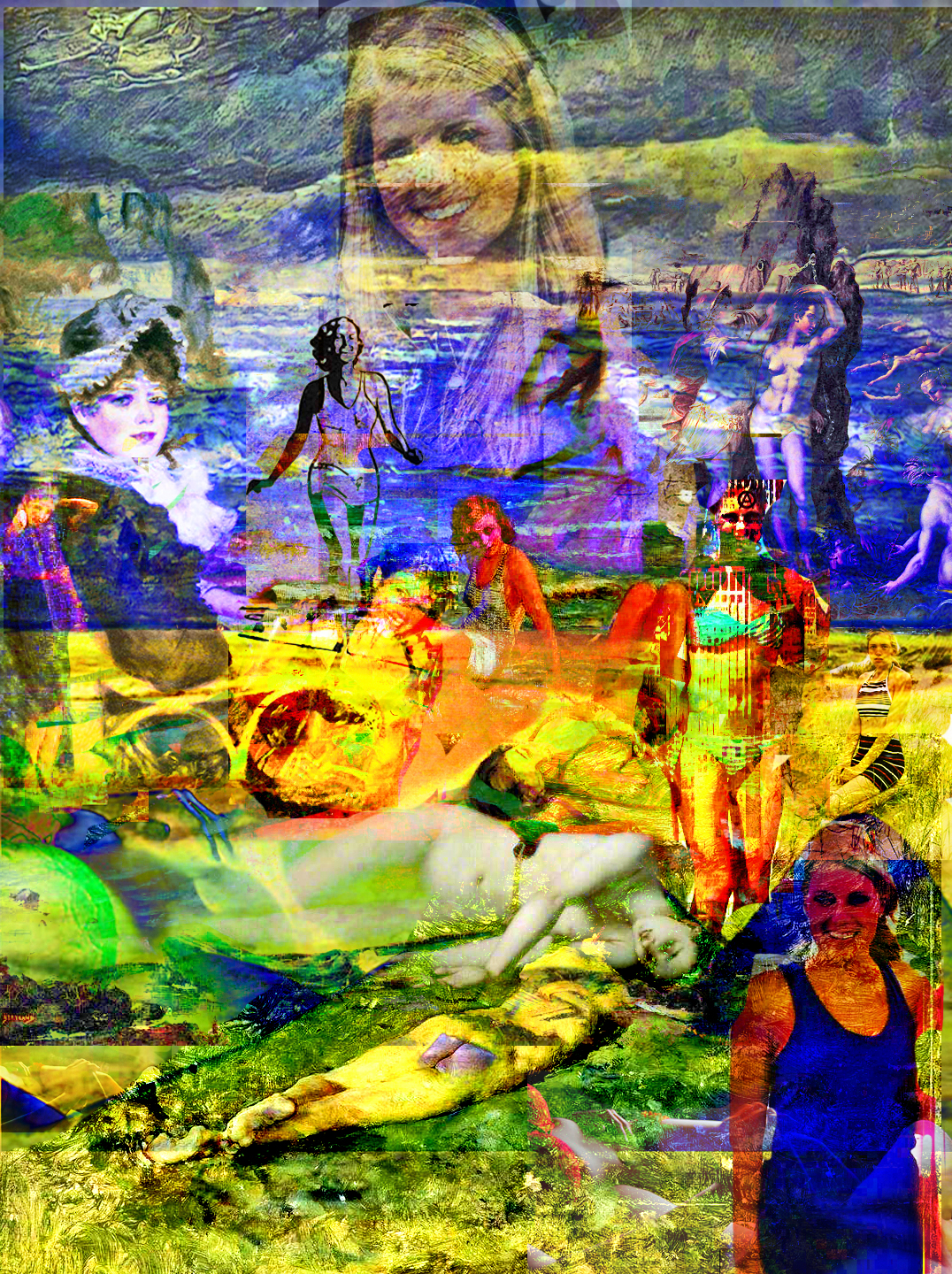
McAleer, Clement, b.1949; Beach

Dawn
Shooting stars
Every kind of bullshit
Cliche out there
Sun sand sea
Blue skies
Crashing waves
Whitened teeth
And tossing
Blonde hair
Your mouth on me
All that jazz
And jizzum

Posted in art, may contain nudity, Poetry, Poetry and Art, Woman | Tagged , , | Leave a comment

Miss Deakins

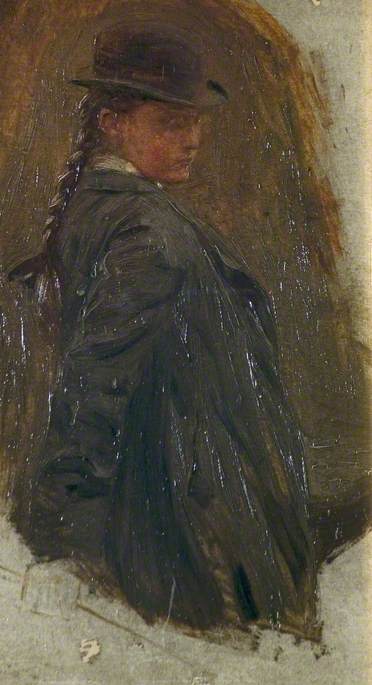
Syddall, Joseph, 1864-1942; Miss Deakins

Joseph Syddall (1864–1942)

Chesterfield Museum & Art Gallery

Posted in art, Woman | Tagged , | Leave a comment

Monroe County Courthouse

courthousepe

Sirens choke the night

Pour darkness, the gift

Of all that flows around

The Monroe County Courthouse

Thunder lightning rain squalls

Feathery sheets of plumage

Through floodlight’s current

Granite statues and shivering flesh

Shadowed in the niches

What happened how did we

End up soaked and sorry

Not half invisible enough

Regretful of every fucked up step

Ah well it all came down

Didn’t it and here

We are

Posted in art, From A hypnagogic Journal, Literature, may contain nudity, Poetry, Poetry and Art, Weather, Woman | Tagged , , | Leave a comment

Happy 4th!

happy4th

Posted in art, may contain nudity, Seasonal, Woman | Tagged , , , | Leave a comment

God & Jesus

aninf

Posted in Archie, Cosmic Verities, religion, Uncategorized | Tagged , | Leave a comment

Art and the Jade

Draper, Herbert James, 1864-1920; Art and the Jade

Herbert James Draper (1864–1920)

Paisley Art Institute Collection, held by Paisley Museum and Art Galleries

Posted in art, GPOY, may contain nudity, Uncategorized | Tagged , | 1 Comment

Nancy Drew Tips:

05

How to protect your lamb from a wildcat

from The Clue of the Whistling Bagpipes

1964

It occurs to me this could also work as a cartoon with the wildcat labeled Trump and Nancy labeled the Scots…

Posted in Books, Nancy Drew, Nature, Uncategorized | Tagged , , | 1 Comment

Since She Went Away, David Bell, New American Library, $16.99.

dbellIf you want a compelling reading experience, just pick up a David Bell book. Reading the first page can be like leaning over a suspense generating machine — the gears of the story will grab any loose time you have and draw you in irresistibly. Take, for instance, the first few lines of his latest, Since She Went Away:

Five police cars. Three news vans. And one coroner’s wagon.

Boom. There’s obviously something intriguing going on here and the reader will want to know what it is.

Bell’s developing story is anything but mechanical, however, but powered, as most good stories are, by realistic, multifaceted characters. It alternates between two viewpoints; that of Jenna Barton and her son Jared. Jenna is a nurse and single mother who can be a little too candid at times. Her main concern these days is her best friend Celia who has been missing for three months. Since the perpetually late Jenna was supposed to meet Celia at the park the night she disappeared, Jenna has been wracked with guilt and obsessed with the search:

Jenna wondered once again how her life had ended up like this — having to tell her son and her best friend’s daughter she was at a crime scene where a part of a woman’s body had been found.

Her son finds that his life has changed too.

It was a first for Jared Barton: a beautiful girl in his bedroom.

But even this teenage dream has its disconcerting edges. His girl has only recently moved into town and has a very controlling father and an extreme reluctance to discuss her past. Jared is as impetuous as his mother, but he tends more to charge headfirst at his problems rather than talk about them. It doesn’t take a clairvoyant to figure out these two mysteries are going to converge, but I defy anyone to predict exactly how things play out.

The plot twists are adroit and believable, but within the mounting suspense there are also important themes about contemporary society. Nowadays a crime, especially one against an attractive woman is almost inseparable from the ghoulish media din that surrounds it, and Jenna is both provoked and captured by the endless scrutiny and speculation, as well as the lower key, yet just a sinister, online chatter that inevitably proliferates.

There’s also a class aspect, as Celia’s husband Ian is the scion of their small Kentucky town’s reigning family, the rich kid who was Jenna’s biggest high school crush, a relationship even more tantalizing because it never developed into anything after the glamorous Celia swooped in to claim him. Yet now the previously indifferent Ian is reaching out to Jenna, even as his mean girl daughter Ursula is trying to connect with Jared in a not so friendly way.

In short, this book has it all — suspense, character, a mousetrap plot and supple prose, all constructed by the masterful Mr. Bell. Just don’t  get sucked into it if you’ve got a pressing obligation.

Posted in Books, Crime Beat, mysteries, Uncategorized | Tagged , | Leave a comment

Apollo and Daphne

2mira04

PELLEGRINI, Giovanni Antonio
c. 1704
Fresco
Villa Alessandri, Mira

“Father, if your waters still hold charms to save your daughter, cover with green earth this body I wear too well,” and as she spoke a soaring drowsiness possessed her; growing in earth she stood, white thighs embraced by climbing bark, her white arms branches, her fair head swaying in a cloud of leaves; all that was Daphne bowed in the stirring of the wind… — Ovid

Posted in art, may contain nudity, Mythology | Tagged , , | Leave a comment

“The Red Parts: Autobiography of a Trial” by Maggie Nelson, Graywolf, $16 and “Jane Doe January: My Twenty-Year Search For Truth and Justice” by Emily Winslow, Morrow, $29.99.


rp

Jdj

I recently read two great true crime narratives, The Red Parts: Autobiography of a Trial by Maggie Nelson and Jane Doe January: My Twenty Year Search For  Truth and Justice by Emily Winslow, that started me thinking about the evolving way we look at crime. Both books demonstrate the seismic effects that advance in DNA testing have had on both prosecuting and narrating crime stories.

Maggie Nelson’s book of poetry Jane: A Murder, about her aunt was about to be published when she got a phone call from the police. Although she had never known her aunt, a University of Michigan student who had been killed thirty-five years earlier, the unsolved murder had resonated within her family and with the writer, who had obsessively sifted through the available sources about the killing and her aunt, including Jane’s diaries. But the Michigan State Police detective on the other end of the line revealed that DNA testing had suddenly revealed the one thing that only one living person knew previously — the identity of the killer.

Emily Winslow had an even more personal collision with violence when, as a college student in the prestigious drama department at Carnegie Mellon University, she was brutally raped in her apartment by an unknown assailant. Although she continued with her life, moving to England and writing mystery novels, she followed her case and others like it, following the advances in DNA testing and the slow testing of an enormous backlog of rape kits, until one day decades later, her assailant was no longer unknown. Both books center around the authors’ experience of the subsequent trials, as both literal and metaphorical witnesses.

In real terms, it’s wonderful that DNA can take so much of the guesswork out of the criminal justice system, but in dramatic terms it forces a departure from the most traditional elements of crime writing. The figure of the detective, for instance, the primal seeker of truth whose idiosyncrasies and brilliance have entertained since Poe’s Dupin, is greatly diminished in such a scenario. There are law enforcement figures in both books, naturally, but in the case of cases so long unsolved, they function more as dogged but frustrated keepers of the flame of the hope of justice, and then, once the conundrum is solved with the aid of a lab report rather than a brilliant deduction, supporters and hand holders of the survivors banded together for the trial. Similarly the victims are not the colorful characters in the village who are either universally hated or loved, producing either too many or too few suspects respectively, but people who were simply unlucky. Even the perpetrators in these books, far from being oversize Moriarty or Lector figures are ciphers whose guilt is clear and motives irrelevant.

The appeal in both books lies in something else entirely. One of the trends in contemporary crime fiction is the movement away from emphasizing the puzzle of solving the crime to the shattering effect of transgressive behavior on the community itself. In our selfie era some of the most vital writing is in the areas of memoir and personal essay and both The Red Parts and Jane Doe January take the examination of the effect of crime to an even greater level of magnification — the impact on two sensitive, finely articulated consciousnesses.

Maggie Nelson has made a name for herself as a brilliant and bracingly honest writer and thinker on a variety of topics, and The Red Parts is a great example of her quicksilver, deeply informed mind at work. As she describes stalking the streets of Ann Arbor, the scene of the trial, fiercely ruminating, the reader is enthralled by her fluid combination of personal history, erudition and theory.

As far as I could tell, stories may enable us to live, but they also trap us, bring us spectacular pain. In their scramble to make sense of nonsensical things, they distort, codify blame, aggrandize, restrict, omit, betray, mythologize, you name it.  This has always struck me as cause for lament, not celebration.

I must say that I wasn’t bowled over by Jane when it came out, but this book tethers Nelson’s rhetorical flights to the familiar structure of a criminal trial, bringing a more focused narrative thrust. The result is an extremely enjoyable book about a horrible subject as an extremely agile and powerful consciousness wrestles with a banal evil that is essentially inexplicable. There’s also a powerful critique of a society that both exploits and brutalizes women and uses the violence against them as entertainment and diversion.

The Red Parts is the length of a sustained essay or novella, which is appropriate, because keeping up with the author’s high-wire mental gymnastics can be exhausting. On the other hand Emily Winslow, who also writes mystery novels, unfolds her personal history with less pyrotechnics but more sustained rigor. Jane Doe January is closer to a traditional autobiography, but centered around a single shocking crime and its effect of her and those around her. One of these effects is an overwhelming thirst for justice, and she relentlessly researches the crime and the eventually unmasked criminal, trying to understand every aspect like a student cramming for an exam, or indeed, a novelist researching their next novel. Meanwhile the trial proceeds in fits and starts, generally playing havoc with her now settled life with husband and children in England. Even as the overdue reckoning of the trial grinds on there are tragic developments in the here and now, reminding the reader that life is rarely really settled.

Stephen Hawking has suggested that the Big Bang could have been caused by the intersection of two universes, a bump that set off the explosion of a new universe. Sometimes I feel like human interactions and relationships are bumps like that and we’re all so enormous with pasts and desires and faults and ambitions that our little meetings have larger, occasionally explosive, effects.

The cumulative effect is tremendously powerful, and challenges received attitudes about “victims” and “actors” (a technical law enforcement term for criminals) in crime narratives. In the end its a story of survival and, indeed, triumph, like the story she tells of the Japanese practitioners of kintsugi, a Japanese method of fixing broken ceramics. As she says “practitioners of this method highlight the repair lines with gold, admitting to the object’s past shatters, incorporating the object’s experience as part of its presentation, and of its changing, growing, aging beauty.”

Posted in Books, Crime Beat, Culture, Literature | Tagged , , , , | Leave a comment